
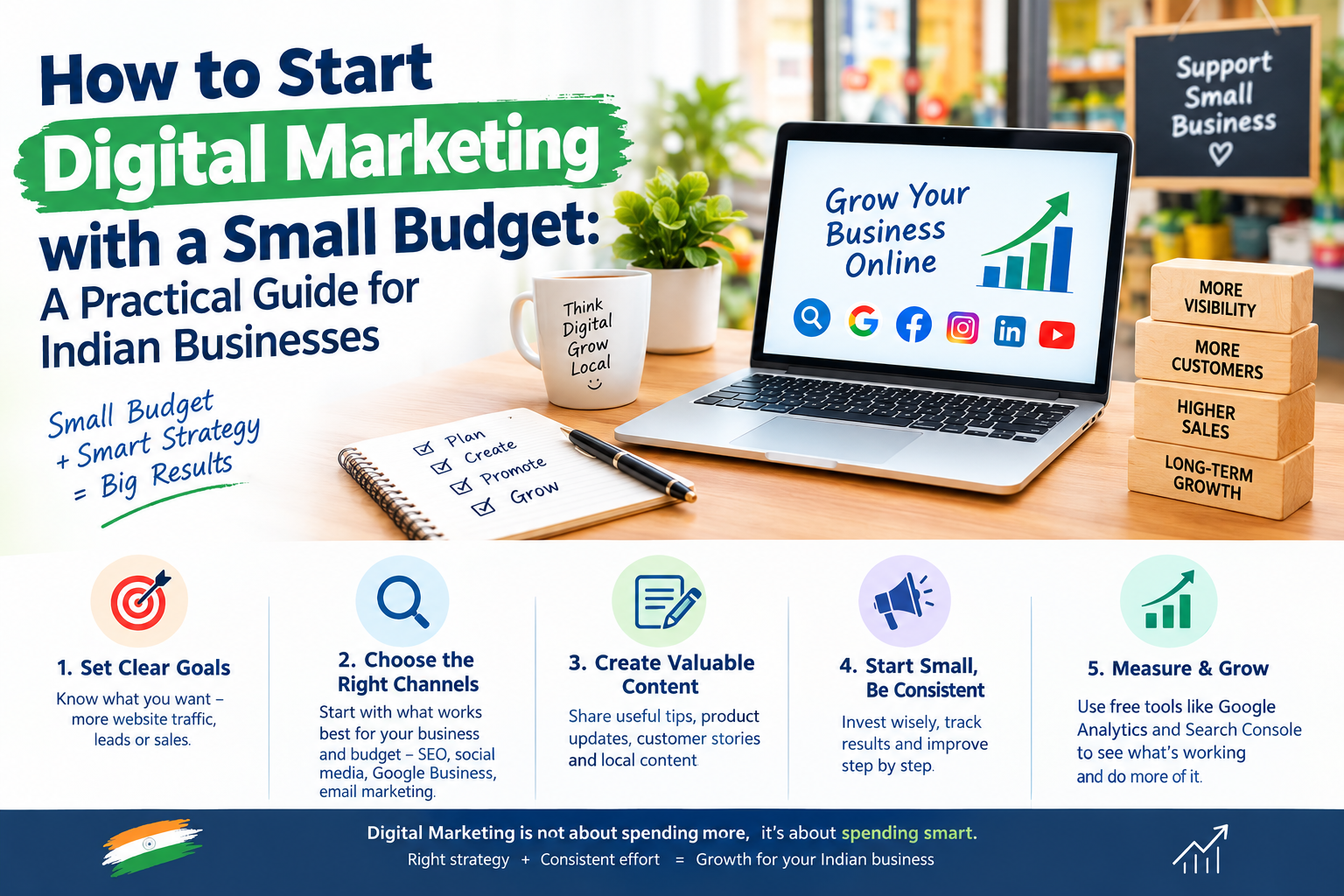
Many business owners believe digital marketing needs a huge budget. In reality, a focused plan with a monthly spend of around ₹20,000 can deliver steady, measurable leads, if the money goes to the right places. This guide explains where to begin, what to prioritise, and what to avoid.
If your business already gets orders through a sales team or referrals, you might wonder why you need online marketing at all. The answer is reach and predictability. A good digital marketing agency helps you:
Digital marketing doesn’t replace your sales team. It gives them warmer, better-informed prospects to talk to.
Before spending a single rupee, answer two questions:
Most failed campaigns don’t fail because digital marketing doesn’t work. They fail because the message reached the wrong audience.
Your website is your 24/7 salesperson. Before running ads, make sure it has:
If your current site is outdated or doesn’t generate enquiries, investing in custom website development first will improve the results of every other channel you add later.
Paid ads stop the moment you stop paying. SEO services build an asset that keeps working. A solid SEO foundation includes:
SEO is a slower channel, but it usually becomes your most cost-effective source of leads over time, especially for service businesses that depend on local searches.
While SEO matures, paid campaigns bring quicker leads. With a limited budget, don’t spread money across every platform. Pick one or two:
A sensible starting split for a small budget is to put most of the spend on the one platform where your customers are most active, and keep a small portion for testing.
Here’s a hard truth: most website visitors don’t enquire on their first visit. Remarketing campaigns show your ads again to people who already visited your site, watched your video or opened your lead form. These audiences already know you, so they convert at a lower cost than cold audiences. For small budgets, remarketing is often the best-value part of the whole funnel.
Content builds the trust that ads alone cannot. Blog posts, case studies, ebooks, short videos and FAQs all help potential customers understand your expertise before they contact you. Strong content marketing also feeds your SEO, gives your sales team useful material to share, and keeps your brand visible between buying cycles.
If you can’t measure it, you can’t improve it. Set up GA4 and Google Tag Manager so you know:
A custom Looker Studio dashboard can then bring all this data into one simple report, so you can review performance in minutes instead of digging through multiple tools each month.
Today, customers read reviews before they call. Respond to feedback promptly, ask happy customers for Google reviews, and keep your messaging consistent across platforms. Good online reputation management quietly increases the conversion rate of every other channel.
Every business is different, but a balanced starting structure might look like this:
| Area | Approximate Share |
|---|---|
| Paid ads (one main platform) | 50–60% |
| SEO and content basics | 25–30% |
| Analytics, tracking and reporting | 10–15% |
Review results after 60 to 90 days, then double down on whatever is producing the best cost per lead.
Digital marketing is not about spending the most. It is about spending smartly: the right audience, the right message and the right channel, backed by data. Start small, measure honestly, and scale what works.
If your earlier in-house campaign didn’t deliver, a structured, multi-channel approach with proper tracking often changes the outcome. Ready to plan a strategy that fits your budget? Talk to a digital marketing consultant and get a tailored plan for your business.
Call us: +91 87621 09764
Yuvika Business Solution
F0-02, 4th floor, 28/A, 80 Feet Rd, Indiranagar, Bengaluru, Karnataka 560097
Email: yuvikadigital@gmail.com